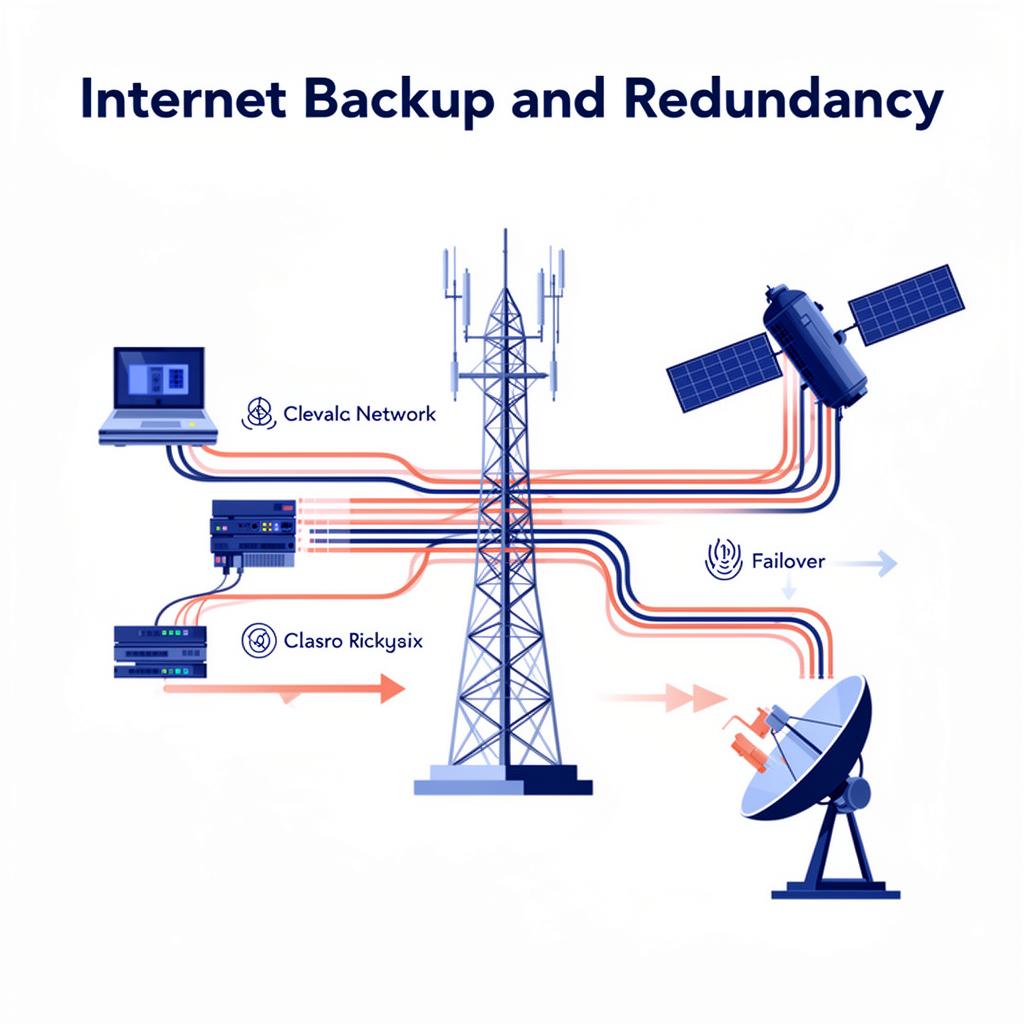
The True Cost of Internet Downtime
When your internet goes down, your business doesn't just slow down—it stops. Credit card terminals go offline. Cloud-based systems become inaccessible. Employees can't access email, files, or collaboration tools. Customers calling in get dead lines if you're running VoIP.
The average cost of IT downtime for a small business is $427 per minute according to recent industry data. Even a two-hour outage—which is a relatively minor event—can cost over $50,000 in lost revenue, productivity, and customer goodwill.
And outages aren't rare. The average business experiences 14 hours of internet downtime per year from ISP issues, construction accidents, weather events, and equipment failures. That's 14 hours of lost business that's entirely preventable.
The average small business loses $427 per minute during internet outages—and experiences 14 hours of downtime per year.
What Is Failover, and How Does It Work?
Internet failover is exactly what it sounds like: a backup connection that automatically activates when your primary connection fails. The transition happens in seconds—often so fast that employees don't even notice the switch.
The most common failover solution for SMBs is a 4G/5G cellular backup. A small router or gateway device sits alongside your existing network equipment, connected to a cellular network. When it detects that your primary connection is down, it instantly reroutes all traffic through the cellular connection.
When your primary connection comes back online, the system automatically switches back. No manual intervention required. No IT team needed. It just works.
4G/5G Failover: The Best Option for Most Businesses
While there are multiple failover options (secondary wired connection, satellite, fixed wireless), 4G/5G cellular failover hits the sweet spot of cost, reliability, and performance for most small-to-mid-sized businesses.
Modern 5G connections deliver speeds of 100–300 Mbps—more than enough to keep all business operations running smoothly. Even 4G LTE provides 25–50 Mbps, which handles email, cloud apps, VoIP, and credit card processing without issues.
The hardware costs $200–500, and monthly cellular plans for failover run $30–75/month. Compare that to the cost of even a single two-hour outage, and the investment becomes a no-brainer.
Choose a failover provider on a different cellular network than your primary ISP's mobile offerings. True redundancy means different infrastructure paths.
SD-WAN: Intelligent Failover for Multi-Site Businesses
If you operate multiple locations or need more sophisticated network management, SD-WAN (Software-Defined Wide Area Network) takes failover to the next level.
SD-WAN doesn't just switch to a backup connection when the primary fails—it continuously monitors all available connections and routes traffic based on application priority. Critical applications like VoIP and payment processing always get the best available connection, while less critical traffic (software updates, backups) uses whatever bandwidth is left.
For businesses with 3+ locations, SD-WAN also simplifies network management by providing a single dashboard to monitor and configure connectivity across all sites.
Setting Up Your Backup Plan: Step by Step
Step 1: Assess your risk. How many hours of downtime can your business tolerate? What's the financial impact per hour? This determines how much to invest in redundancy.
Step 2: Choose your failover type. For most SMBs, a 4G/5G cellular failover router is the right answer. For multi-site operations or businesses with strict uptime SLAs, consider SD-WAN.
Step 3: Test the failover. Don't just install it and hope it works. Simulate an outage by unplugging your primary connection and verify that the failover activates within your acceptable timeframe. Test critical applications—VoIP, payment processing, cloud tools—to ensure they work on the backup connection.
Step 4: Monitor continuously. Set up alerts for failover events so you know when your primary connection is having issues. Track the frequency and duration of failover events—if they're increasing, it may be time to switch primary ISPs.
Don't Wait for an Outage to Act
The best time to set up internet failover was before your last outage. The second best time is now. Internet reliability is not improving—it's getting more complex as businesses become more dependent on cloud services and online tools.
A failover solution is the cheapest insurance policy your business can buy. For $50–75/month, you eliminate the risk of costly outages and ensure your business keeps running no matter what happens to your primary connection.
Key Takeaways
- Internet downtime costs SMBs an average of $427 per minute
- 4G/5G cellular failover provides reliable backup at $30–75/month
- Failover switches automatically in seconds—no IT intervention needed
- SD-WAN adds intelligent traffic routing for multi-site businesses
- Test your failover regularly—don't wait for a real outage to find problems
Need Help With This?
Our team specializes in connectivity. Let's talk about how we can help your business.
Get a Free Consultation